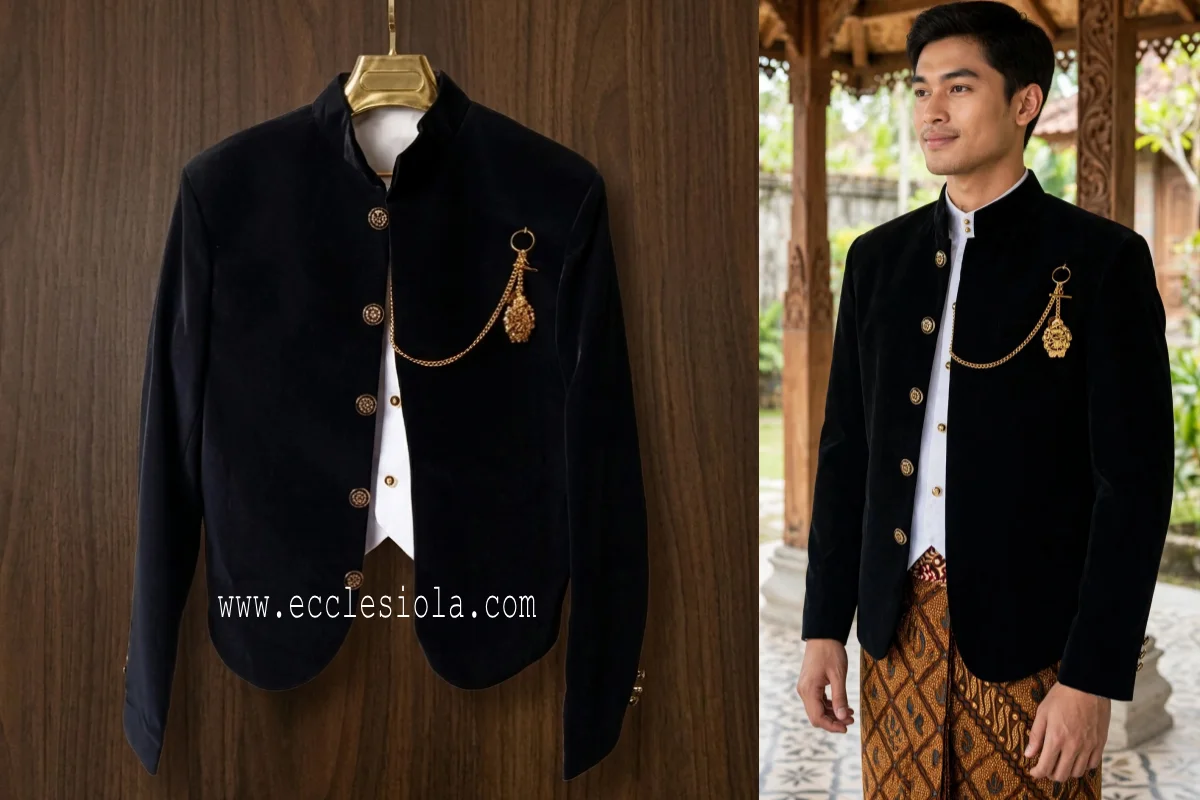
Beskap is one of the best-known forms of traditional Javanese menswear. It is often worn for formal ceremonies, weddings, and state occasions. Unlike everyday garments such as the surjan lurik, beskap is formal attire (busana kebesaran) associated with dignity, elegance, authority, and established cultural etiquette.
This guide explains what makes a beskap distinctive, outlines its history and main styles, and compares formal menswear traditions from Surakarta (Solo) and Yogyakarta (Jogja).
1. What Is a Beskap? Key Characteristics
A beskap is a structured, buttoned jacket made from plain fabric—commonly black, white, cream, or gold-toned—with a standing collar rather than the wide folded lapel of a Western suit.
- Standing collar (jejer): A collar that circles the neck without a folded suit lapel, similar to a mandarin collar.
- Asymmetrical buttons: The buttons run diagonally from the neck toward the right side of the waist or underarm, rather than straight down the center like a modern jacket.
- Back opening (coakan keris): The lower back is cut in a curved shape so a keris worn at the back of the waist can sit neatly without being blocked by the jacket.
2. A Brief History of the Javanese Beskap
A. Name, Origins, and Cultural Exchange
The term beskap is often associated with Dutch influence and the short formal jackets that developed during the colonial period. Its use grew rapidly from the late eighteenth to the nineteenth century, after the 1755 Treaty of Giyanti divided the Islamic Mataram Kingdom into the Sultanate of Yogyakarta and the Surakarta Sunanate.
The garment reflects cultural exchange: traditional Mataram clothing values came together with the neat, structured, formal influence of European military and government uniforms.
B. Development in the Palace Environment
Beskap first developed within the royal courts as official attire for nobles, palace attendants (abdi dalem), and members of the royal family. Over time, it became more widely adopted as formal clothing for wedding receptions, traditional celebrations, and important commemorative occasions.
3. Main Javanese Beskap Styles
Within Javanese dress culture, beskap has developed into several styles based on function, regional tradition, and level of formality.
1. Beskap Solo (Standard or Kakap Style)
This classic style has a diagonal button line running from the neck toward the right side. The front is fully closed up to the neck and is one of the standard forms of formal dress in the Solo tradition.
2. Beskap Landung
Beskap Landung has a longer lower section that covers the hips. Its silhouette resembles a tunic or long European jacket, giving it a classic and formal appearance.
3. Beskap Langenharjan
This style developed in the Surakarta royal tradition and is often associated with the Langenharjo retreat. Its defining feature is a V-shaped opening at the chest, worn with a white standing-collar shirt, bow tie, and vest. Langenharjan is commonly chosen for evening receptions, formal events, or Solo-style Javanese weddings.
4. Beskap Hewes
Beskap Hewes is a Yogyakarta-style variation with an open front that reveals the white shirt and bow tie underneath. It is often worn by a Yogyakarta-style groom or for certain formal occasions.
5. Beskap Sikepan
Beskap Sikepan is designed with an open chest or front buttons that are intentionally left undone, allowing a contrasting inner garment such as a vest or kutangan to show. It is often associated with palace nobility or wedding attire.
4. Key Differences Between Solo and Yogyakarta Beskap
The two traditions may look similar at first glance, but Solo and Yogyakarta formal menswear differ in technical details and cultural styling.
| Feature | Solo (Surakarta) Beskap | Yogyakarta (Jogja) Beskap |
|---|---|---|
| Main formal garment | Beskap Solo with a diagonal button line, or Beskap Langenharjan. | Surjan Takwa, Beskap Hewes, or Beskap Sikepan in the classical Mataraman Yogyakarta tradition. |
| Lapel or button arrangement | A pronounced diagonal line toward the lower right, with overlapping buttons known as tangkeplakan. | More symmetrical in appearance or arranged with distinctive straight buttons, as in Surjan Takwa. |
| Open-chest style | Langenharjan has a curved V opening worn with a white shirt, bow tie, and vest. | Hewes has a more angular or straight opening, worn with a standing-collar shirt and bow tie. |
| Blangkon pairing | A Solo blangkon has a flat or flattened back, known as papat or trepes. | A Yogyakarta blangkon has a rounded protrusion at the back called a mondholan. |
| Jarik fold (wiron) | The white fabric edge, or seretan, is folded inward and concealed. | The white fabric edge, or seretan, is visible on the front-most fold. |
| Keris style | A Solo keris uses a sheath such as Ladrang or Solo Gayaman and is tucked at a diagonal toward the right. | A Yogyakarta keris uses a sheath such as Branggah or Jogja Gayaman, worn at the characteristic Jogja angle. |
5. How to Wear a Beskap Properly
Wearing a beskap requires attention to detail so the outfit looks neat and proportionate according to traditional dress conventions (pakem).
- Inner layer: Wear a thick white undershirt, or a dedicated shirt when wearing the Langenharjan or Hewes style.
- Lower garment (jarik): Wear a batik cloth or jarik folded into the traditional wiron. The hem should fall just above the ankles.
- Sash and stagen: Secure the jarik with a stagen, then add a sabukwala or eblek and a timang, a decorative buckle.
- Putting on the beskap: Insert your arms and fasten the buttons from the inner row to the outer row.
- Positioning the keris: Place the keris in the back of the sash (nyengkelit keris), angled toward the right according to the relevant palace tradition.
- Accessories: Choose a blangkon that matches the Solo or Yogyakarta style, and wear selop, the traditional closed Javanese sandals.
6. Conclusion
The Javanese beskap reflects the high value placed on aesthetics, precision, and formal presentation in Indonesian dress culture. Through a combination of local design and European influence, it became a symbol of honor, composure, and authority for Javanese men.
Solo and Yogyakarta styles each have their own visual language and customary rules. Together, they show the diversity of the heritage that developed from the former Islamic Mataram realm and continues to be preserved today.